cavcalc.calculate.calculate#
- cavcalc.calculate.calculate(target: Optional[Union[str, ParameterType]] = None, meshes: Optional[Union[bool, str, Sequence[Union[str, Sequence[str]]]]] = None, **kwargs)#
Calculates a target parameter from an arbitrary number of physical arguments.
If no target is specified then the default behaviour is to calculate all computable parameters from the given arguments.
- Parameters:
- targetstr |
ParameterType, optional The target parameter to compute, can be specified as a string (see drop-down box above) or a constant of the enum
ParameterType. Defaults toNoneso that the function computes all the parameters it can from the given inputs.- meshesstr | bool | Sequence[str | Sequence[str]], optional
Parameter combinations from which to construct mesh-grids. This argument can given in a number of different ways, e.g:
meshes=True: constructs mesh-grids from the array-like arguments in the order in which they are given to this function.
meshes=”g1,g2”: makes mesh-grids from arguments g1 and g2, respectively.
meshes=[“g1,g2”, “R1,R2”]: makes mesh-grids from g1 and g2, respectively, and also makes mesh-grids from R1 and R2, respectively.
meshes=(“L, R1, R2”): makes mesh-grids from L1, R1 and R2, respectively.
- **kwargsKeyword Arguments
See the drop-down box above for details.
- targetstr |
- Returns:
- out
SingleOutput|MultiOutput An output object containing the results; with methods for accessing, displaying, and plotting them. If a
targetwas given, and was notNone, then this object will be aSingleOutputinstance, otherwise it will be aMultiOutputobject.
- out
Examples
The following imports are used for the below examples:
import cavcalc as cc
import numpy as np

# This configures the matplotlib rcParams for the session
# to use the style-sheet provided by cavcalc
cc.configure("cavcalc")
Compute and show all determined properties from the cavity length and round-trip Gouy phase:
print(cc.calculate(L=1, gouy=300))
Given:
	Cavity length = 1 m

	Round-trip Gouy phase = 300 deg

	Wavelength of beam = 1064 nm

Computed:
	FSR = 149896229.0 Hz
	Mode separation frequency = 24982704.83333333 Hz

	Position of beam waist (from first mirror) = 0.5 m

	Radius of curvature of both mirrors = 0.5358983848622454 m

	Radius of beam at mirrors = 0.8230209218477419 mm
	Radius of beam at waist = 0.21301348909202888 mm

	Stability g-factor of cavity = 0.7500000000000001
	Stability g-factor of both mirrors = -0.8660254037844387

	Divergence angle = 0.09109759584821303 deg
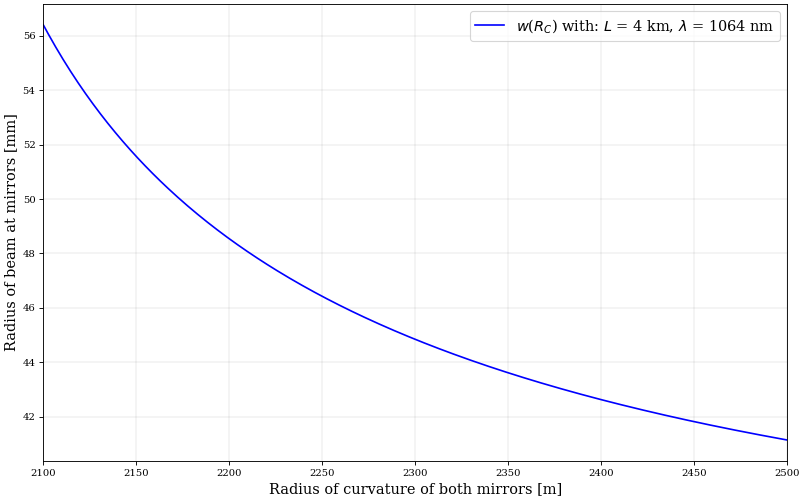
Calculate, and plot, the beam radii on the cavity mirrors over a range of radii of curvature:
cc.calculate("w", L="4km", Rc=np.linspace(2.1e3, 2.5e3, 300)).plot();
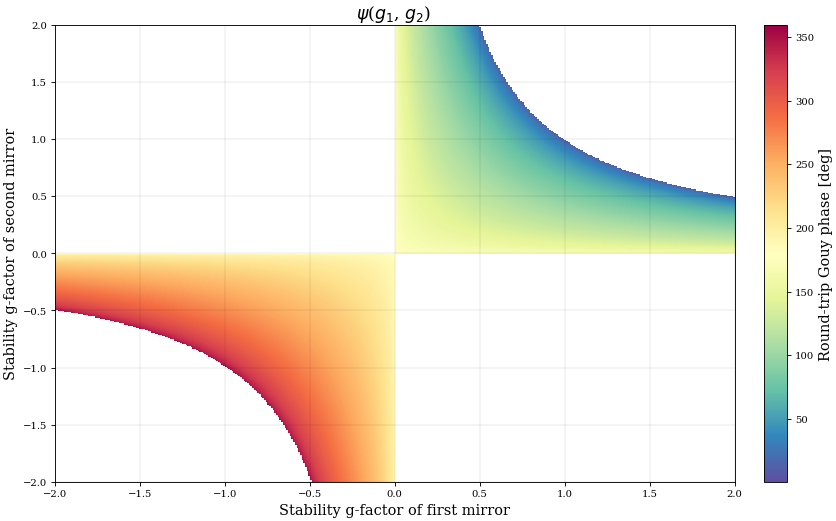
Make an image plot of the round-trip Gouy phase calculated on a grid over the stability factors of the cavity mirrors:
g_arr = np.linspace(-2, 2, 399)
# Setting meshes=True here will construct mesh-grids from all array
# parameters in the order that they are specified
cc.calculate("gouy", meshes=True, g1=g_arr, g2=g_arr).plot(cmap="Spectral_r");
Get the radius of curvature of the cavity mirrors given the beam radii on them:
out = cc.calculate(L="3cm", w1="100um", w2="120um")

# .value is the pint.Quantity object
print(f"Rc1 = {out.get('Rc1').value.to('mm'):~}")
print(f"Rc2 = {out.get('Rc2').value.to('mm'):~}")
Rc1 = [18.309691973947547 82.98215718293483] mm
Rc2 = [20.784454394584024 53.897359137391966] mm
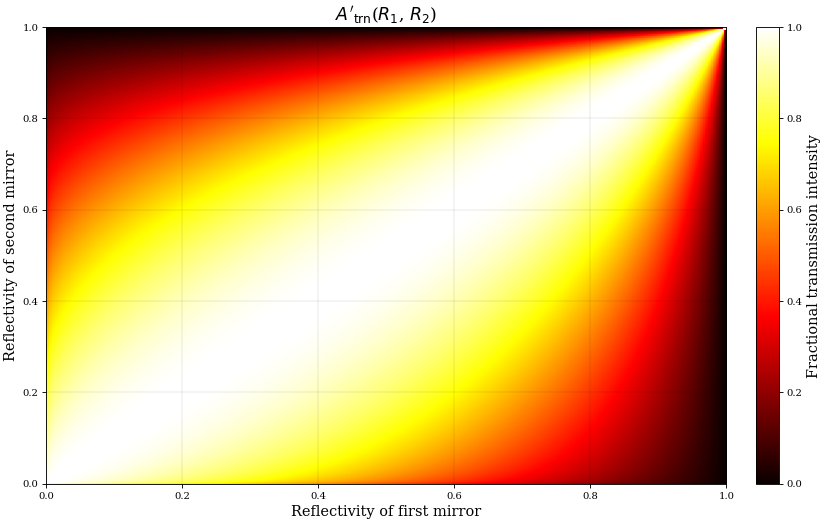
Compute the fractional transmission intensity over a grid of the mirror reflectivities:
cc.calculate("Atrn", R1=np.linspace(0, 1, 250), R2="R1", meshes=True).plot(cmap="hot");
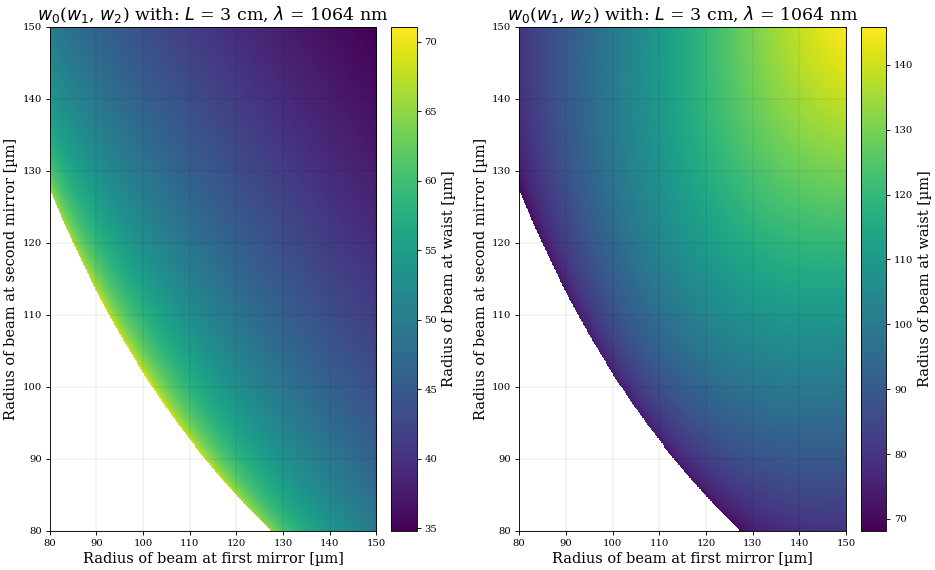
Plot the radius of the beam at the waist position, as a function of the beam radii on the mirrors; whilst using
configure()to temporarily override the default units (loaded from the config files) for beam-size type parameters:w_arr = np.linspace(80, 150, 499) with cc.configure(beamsizes="um"): fig = cc.calculate("w0", L="3cm", meshes=True, w1=w_arr, w2=w_arr).plot(show=False) fig.subplots_adjust(wspace=0.25)